


How to Verify the OSPF External Forwarding Address on Cisco IOS XE
R1 has learned 203.0.113.0/24 from OSPF. R2 redistributed the route, yet R1 sends traffic straight to the external gateway. Another router might show the same advertisement in its database without installing the prefix at all. Both outcomes make sense once you separate the router that originated the LSA from the address used to forward packets.
In this IOS XE lab, R1, R2, and the external gateway share the Ethernet transit 192.0.2.0/24. R1 is 192.0.2.1. R2, the ASBR, is 192.0.2.2 and has router ID 198.51.100.2. R2 redistributes a route to 203.0.113.0/24 whose next hop is the gateway at 192.0.2.9. R1 and R2 participate in OSPF on the transit.
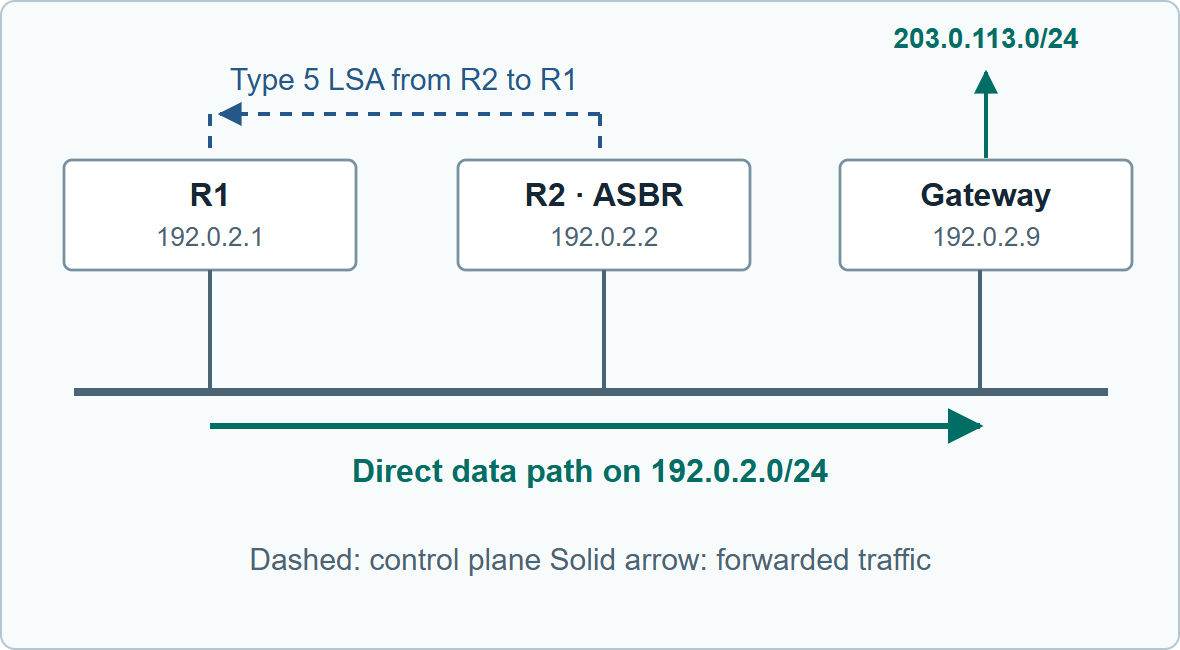
Read both addresses in the Type 5 LSA
Start at R1 and inspect the external advertisement. This abbreviated output is illustrative. Check the mask as well as the link-state ID so you are examining the intended prefix.
R1# show ip ospf database external 203.0.113.0
  Link State ID: 203.0.113.0
  Network Mask: /24
  Advertising Router: 198.51.100.2
  Metric Type: 2
  Metric: 20
  Forward Address: 192.0.2.9
Advertising Router identifies the OSPF router that originated this LSA. You can use that router ID to find the redistribution policy. Forward Address tells R1 what to resolve when it calculates the route. Here that is the gateway at 192.0.2.9. If the field is 0.0.0.0, OSPF instead resolves the path toward the advertising ASBR.
Prove where the traffic leaves
Check the route to the forwarding address, then check the external prefix and an address inside it. R1 is attached to the same transit network, so the gateway is directly reachable in this lab. The lookup for the gateway can show a connected route. You do not need to see a separate O entry for that neighbor’s address.
R1# show ip route 192.0.2.9
R1# show ip route 203.0.113.0 255.255.255.0
R1# show ip cef 203.0.113.1 detail
Expect the installed external route to use 192.0.2.9 on the transit interface. CEF for 203.0.113.1 should resolve to that same neighbor in the lab. If the prefix looks right but an actual test address still exits elsewhere, check that address for a more-specific route before revisiting redistribution.
When the LSA exists and the route does not
Now consider a remote router that receives the same LSA. To use a nonzero forwarding address, OSPF needs an eligible path through its internal topology. On R1 the transit is directly connected and participates in OSPF. A remote router needs an intra-area or inter-area path to that transit address. Learning a covering route only as another OSPF external does not satisfy the check. The Type 5 LSA can remain visible even though OSPF declines to install the external destination on that router.
Look up 192.0.2.9 on the failing router and inspect the type of the covering route. If the eligible path is missing, trace the transit network’s internal advertisement and any area summarization. If resolution is valid, check for competing routes to 203.0.113.0/24. Working through those checks in that order distinguishes an unresolved forwarding address from a route that lost to another candidate.
References: RFC 2328, external route calculation and Cisco’s OSPF forwarding-address examples.